

Automatic Merge Request reviewer with AutoCodeReview
Article co-authored by : Kilian Bauvent (Lead engineer), Benoit Verhaeghe (Project manager and Techn Lead), Marius Pingaud (Developer on BL.CodeRules and diagram designer), Nicolas Hlad (Blog post author and survey designer) On the importance of Merge Requests The overall Merge request Process at Berge-Levrault Let us start by giving the

Experimenting with Innovation in Real-Life Situations: the Key to User-Centered Co-Design
Key words: Innovation – Living Lab – User-centered co-design – Real-life situation – Human and Social Science – Safety – Market launch Innovation at the heart of Berger-Levrault’s strategy A long tradition Innovation is not simply the emergence of new ideas, but their effective implementation to meet the challenges of

Automatic Evaluation of LLM and RAG: Foundations and Established Methods
In professional environments, an increasing number of companies are integrating Large Language Models (LLM) and Retrieval-Augmented Generation (RAG) solutions to automate specific tasks or support their teams. However, ensuring the accuracy and relevance of these systems’ responses is critical, particularly when handling sensitive data or high-stakes business decisions. Evaluating these

From the Iberian sun to the Rising sun for federated learning
On September 2024, we had the opportunity to attend two international conferences related to a segment of our work in artificial intelligence : Data Training Without Perturbative Adjustments for Predictive Maintenance The FLTA24 took place from September 17 to 19 in Valencia, Spain. As part of this research, we studied

Discover our 2024 Research & Innovation Yearbook!
We are delighted to present the first edition of the Research and Innovation Yearbook. This annual retrospective reflects the commitment and ambition of our Research and Technological Innovation Department at Berger-Levrault (also available in French and Spanish versions below). By highlighting our most audacious projects and innovative initiatives, we hope
You can not avoid it! — measuring the energy consumption of software systems has become essential
Measuring the consumption of software systems is becoming increasingly important for industries. Software systems accounted for 6% of the world’s energy in 2019, surpassing civil aviation for gas emissions. Governments and European administrations must consider software energy consumption when selecting products to reduce the ecological impact. Thus, it becomes essential

WeMagnus intelligent assistant: digital innovation for City Hall General Secretaries
As a management platform dedicated to local authorities, Berger-Levrault’s WeMagnus software stands out for solutions based on the latest advances in artificial intelligence (AI) and automated information processing. This new Intelligent Assistant offers users precise, contextualized support. But how was this tool designed? What technologies does it embody? What are
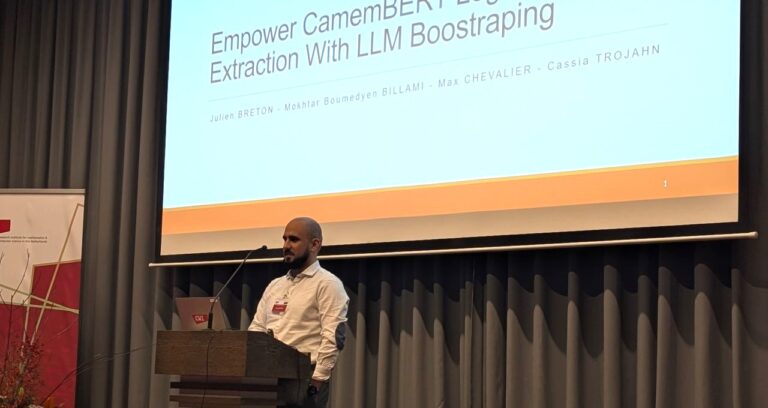
Julien at EKAW 2024 for his work on extracting legal data from LLMs
On December 3, 2024 in Amsterdam, Julien Breton – Research Engineer at Berger-Levrault (Team BL.Research) took part in the EKAW 2024 (European Knowledge Acquisition Workshop) conference. His paper demonstrates how the alliance between large language models (LLMs) and software architectures can optimize data annotation: a consequent time and cost saving,
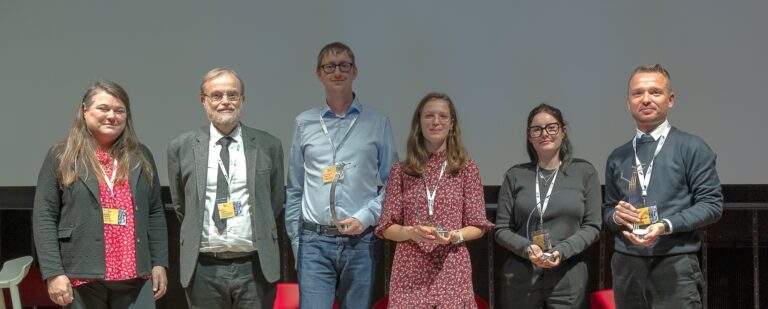
Benoit receives the Prix Science Ouverte 2024: Recognition of excellence and openness in Research at Berger-Levrault
In a world where science plays a crucial role in meeting economic, environmental and societal challenges, the notion of openness in research is taking on strategic importance. Organised by the Committee for Open Science (CoSO) and supported by the French Ministry of Higher Education and Research, the Open Science Awards

Automate the discovery of anomalous behaviour with unsupervised anomaly detection
Unsupervised anomaly detection makes it possible to automate tasks relating to the maintenance of equipment and infrastructure, which until now have been carried out by experts. One of the features of the BL.Predict equipment management platform is the ability to manually define alert thresholds so that you are warned when