

Introduction
For several decades, enterprise software has been shaped by a fragile compromise between technical complexity and user readability. Systems accumulate features, formalise rules, store data, and generate documents, while leaving users to reconstruct meaning and sequences of actions themselves. “There is no silver bullet”, wrote Fred Brooks in a 1986 paper on the inherent limits of software engineering (Brooks 1986). The statement remains strikingly relevant today. It reminds us that major transformations in software rarely come from sudden breakthroughs, but from gradual reconfigurations, where progress stems from redistributing this essential complexity.
Agentic AI fits squarely within this dynamic. It is not a magical promise, rather, it revisits a longstanding ambition to coherently align user intent, rules, documentary corpora, data structures, and actionable capabilities within heterogeneous information systems.
This moment has not emerged by chance. It results from a gradual convergence of technical capabilities that have now reached sufficient maturity to make operational what previously remained at the level of prototypes or demonstrations. Models are increasingly able to perform multi-step reasoning, use tools, manipulate documents, and interact with distributed software environments. At the same time, an infrastructure layer is stabilising around emerging standards such as the Model Context Protocol which formalises how assistants connect to the systems where data and capabilities actually reside (Anthropic 2024).
This is where the decisive shift lies. For decades, software has been structured around screens that organise interaction. Today, it is evolving into a set of modular, exposed, orchestrable and governable capabilities, where access is no longer limited to interfaces but increasingly driven by expressed intent. Software is not disappearing, it is fundamentally changing how we access it.
From enterprise software to intelligent orchestration
Scientific and technological focus
This transformation requires clarifying a persistent ambiguity. A chatbot produces answers. A copilot assists with tasks. An agent, by contrast, operates within constraints, using tools and executing actions on behalf of a user. This distinction is not merely functional, it reflects a shift in operational nature, from a logic of response to a logic of engagement within the system.
It is precisely in this space that MCP servers become structurally significant. Their role is not to layer artificial intelligence on top of existing systems, but to make their capabilities intelligible, discoverable and actionable by agents. Where traditional APIs expose functions, MCP servers formalise an environment of use, an interaction grammar, and a contractual framework understandable by the model (Model Context Protocol specification 2025). This evolution is not only technical, it is also semiotic.
In this context, an agent’s performance no longer primarily depends on its conversational abilities, but on the quality of the context in which it operates. The notion of context engineering (Engineering at Anthropic 09/2025) refers to the dynamic composition of instructions, memory, tools, external data, constraints and access rights. This is not about maximising information, but about making trade-offs under constraints. Too little context leads to blindness, too much leads to confusion. The challenge becomes one of contextual relevance rather than informational exhaustiveness.
This reconfiguration shifts the core question. It is no longer simply about what an agent can do, but under what conditions it can account for what it does. Action without explanation, without traceable sources, without logging or reversibility, cannot be considered progress in an industrial setting. It introduces opacity that is incompatible with accountability.
Credible agentic systems are therefore structured around an architecture of proof, explicitly defined tools, bounded memory, traceability mechanisms, supervision layers, and evaluation protocols. Performance becomes inseparable from justification.
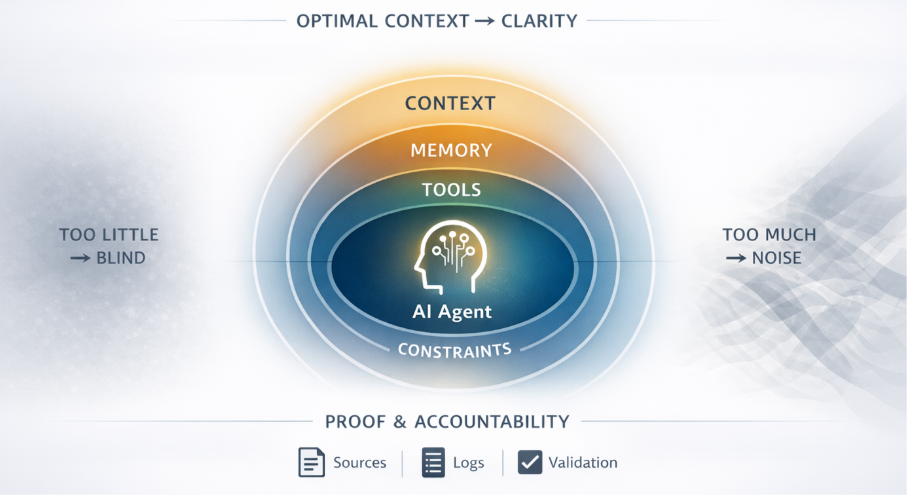
Enterprise systems shift from isolated applications to orchestrated capabilities, where effectiveness relies on carefully calibrated context. The objective is not to accumulate information, but to operate within constraints: insufficient context limits understanding, while excess creates noise. What matters is not completeness, but selecting what is truly relevant.
Innovation focus
Within this perspective, initiatives such as Athena, Berger-Levrault’s agentic platform, follow a coherent trajectory. Agent specialisation, structured memory management, GraphRAG integration, attention to computational frugality, and traceability of actions all reflect the same logic of controlled orchestration rather than indiscriminate amplification of capabilities.
This approach aligns with a view increasingly shared among leading actors in the field. Production efficiency does not stem from maximum sophistication, but from controlled, transparent and evolvable composition (Engineering at Anthropic 12/2024). Complexity is a structural cost that must be justified by demonstrable operational value.
For a software publisher, the strategic shift is therefore clear. Value no longer resides solely in the interface, but in the ability to expose business capabilities in a way that orchestration systems can exploit. SaaS remains relevant, but its centre of gravity is shifting. Interfaces remain essential for control, auditing and exception handling. However, access to business functions is increasingly mediated by intentions, translated into tool-based, traceable and governed sequences of actions.
Use cases
In the public sector, for instance, an agent can assist in drafting a municipal deliberation by reconstructing the legal and documentary context, identifying required documents, and producing an initial draft for validation. It does not replace decision-making, but restructures the cognitive effort required to reach it.
In industrial maintenance, the challenge lies in maintaining continuity across symptoms, historical data, inventory, and technical documentation. The agent acts as a coherence operator, capable of articulating these dimensions in real time, thereby reducing contextual fragmentation, a frequent source of inefficiency.
In regulatory and documentary environments, the transformation consists in moving from passive corpora to operational memory. Agents can monitor, compare, explain and qualify uncertainty, introducing a new form of informational vigilance.
Perspectives
Scientific and technological outlook
The future of agentic AI is less about general-purpose omniscient systems than about a fabric of specialised, interconnected, tooled and governed agents. The emergence of standardised frameworks such as MCP, now supported by open governance bodies, signals a transition towards shared infrastructure (Linux Foundation 12/2025).
In this movement, governance ceases to be peripheral, it becomes intrinsic to system architecture. Integrating regulatory requirements, human oversight mechanisms and security constraints fundamentally reshapes how systems are designed. A high-performing agent is no longer defined by its ability to impress, but by its capacity to operate within a controlled framework.
Berger-Levrault product outlook
For Berger-Levrault, this dynamic outlines a clear trajectory. Athena can evolve from an assistance paradigm to one of cross-functional orchestration of software capabilities. The challenge is no longer to add an assistant to each product, but to build a shared foundation that exposes, contextualises and traces actions.
The AI of tomorrow will not be measured by its apparent power, but by the robustness of the frameworks within which it operates. It will not represent a break from software, but the culmination of a gradual transformation towards responsible architectures, where action remains inseparable from its justification.