

1. Introduction
Artificial Intelligence is reshaping the way legal professionals access, analyze, and reason over information. Retrieval-Augmented Generation (RAG) has become the foundation of many Legal AI assistants, enabling Large Language Models (LLMs) to retrieve relevant legal documents before generating responses (Li et al., 2025).
This approach has significantly improved the reliability of generative AI by grounding responses in authoritative sources rather than relying solely on a model’s internal knowledge. While semantic retrieval performs well for many information-intensive tasks, the legal domain presents unique challenges (Reuters et al., 2025).
2. Why Legal Knowledge Requires More Than Semantic Retrieval
Legal knowledge differs fundamentally from many other domains. Laws refer to other laws, regulations amend or repeal previous provisions, court decisions establish precedents, and legal frameworks continuously evolve as legislation changes and new judicial interpretations emerge. Legal knowledge is therefore not static or contained within individual documents—it exists as a dynamic network of interconnected relationships.
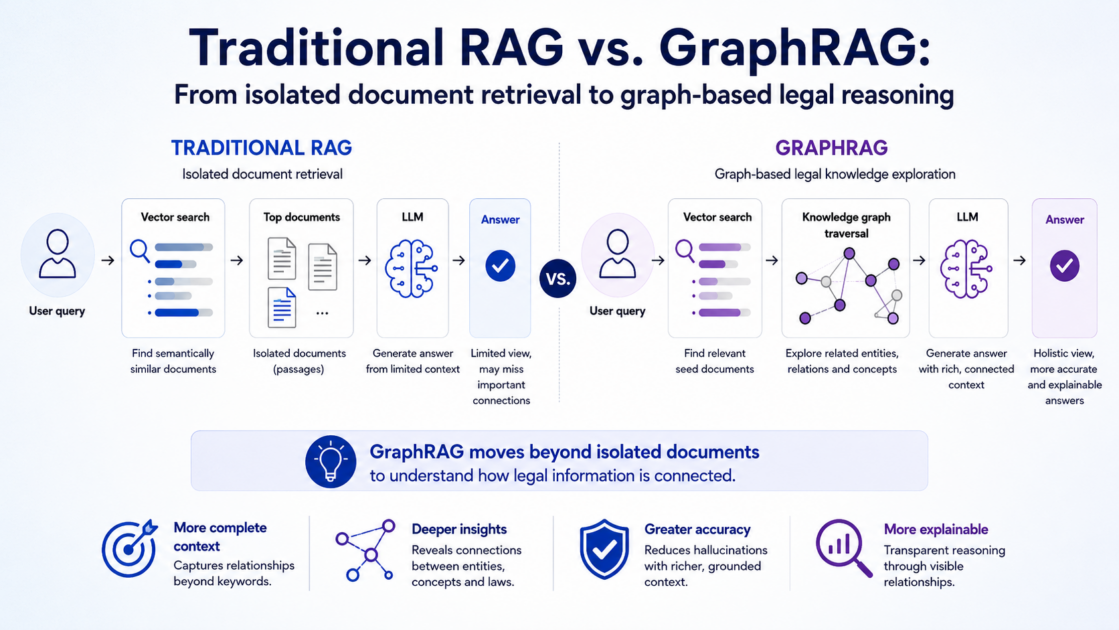
These characteristics reveal one of the main limitations of traditional RAG systems: they rely primarily on semantic similarity. While highly effective at retrieving relevant passages, they are less capable of understanding how legal sources relate to one another. A question about public procurement, maintenance requirements, or urban planning may require connecting legislation, implementing regulations, case law, and administrative guidance that are legally related but not necessarily semantically similar.
As legal repositories continue to grow in size and complexity, retrieving the “right document” is no longer sufficient. AI systems must also understand how legal concepts, obligations, and precedents connect within the broader legal ecosystem.
This is where GraphRAG introduces a new paradigm (Zhu et al., 2025). By combining vector search with knowledge graphs, it enables AI systems to move beyond local retrieval and toward global reasoning, providing richer context, greater explainability, and a representation of legal knowledge that more closely reflects how legal professionals reason (see Figure 1).
3. How GraphRAG Enables Global Reasoning
3.1. Building Legal Knowledge Graphs
GraphRAG relies on a fundamental component: a knowledge graph that represents legal entities and the relationships between them. While general-purpose knowledge graphs such as Wikidata or DBpedia are valuable for many domains, they are rarely sufficient for specialized legal applications.
Organizations working with legal knowledge typically manage domain-specific collections of legislation, regulations, contracts, case law, and internal documentation. As a result, developing an effective GraphRAG solution often begins with constructing a dedicated legal knowledge graph from the targeted legal documents.
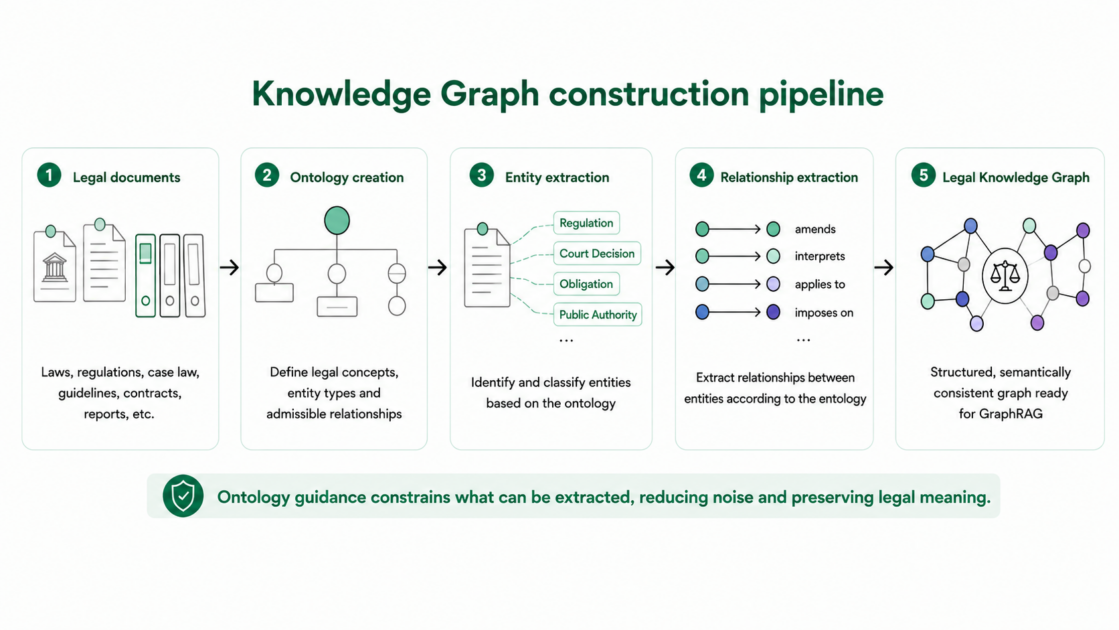
Building a legal knowledge graph goes far beyond identifying entities. The real challenge lies in extracting relationships while preserving the legal semantics expressed in the original text. It requires extracting meaningful relationships that faithfully represent the legal semantics embedded in the text.
3.2. Why Modeling Legal Knowledge Matters
Not all GraphRAG systems build knowledge graphs in the same way. Many existing approaches generate graphs by extracting text snippets or converting documents into simple subject–predicate–object triples. While effective for connecting pieces of information, these graphs often remain close to the original text and capture only limited domain semantics.
In legal AI (Zhong et al., 2020), however, how knowledge is modeled matters. Legal concepts and relationships should reflect their actual meaning, not just textual co-occurrence. Modeling the graph with a domain ontology helps define consistent entity types and meaningful relationships, resulting in a more coherent representation of legal knowledge. This is particularly important because legal language is highly precise. A small change—such as replacing “may” with “must” or omitting a condition—can completely alter the interpretation of a legal provision. By guiding knowledge extraction with a well-defined semantic model, GraphRAG can reduce extraction noise and provide a stronger foundation for accurate retrieval and trustworthy legal reasoning (see Figure 2).
3.3. From Retrieval to Graph-Based Reasoning
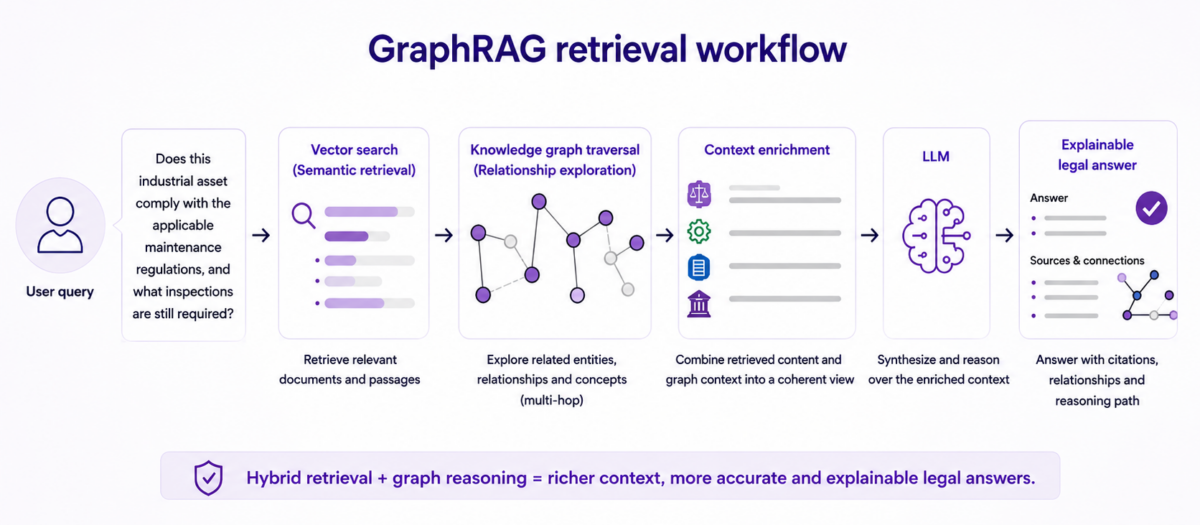
Once the knowledge graph is built, it complements the vector database used in traditional RAG systems. Instead of relying exclusively on semantic similarity, GraphRAG combines two complementary retrieval mechanisms. The first is vector search, which identifies documents and passages that are semantically relevant to the user’s query. The second is graph exploration, which traverses the relationships between legal entities to discover additional context, dependencies, and related concepts that may not be retrieved through embeddings alone.
Together, these two retrieval mechanisms provide LLMs with a richer and more coherent context for answer generation. Rather than simply retrieving isolated text fragments, the system reconstructs the legal landscape surrounding the user’s question by connecting regulations, judicial decisions, legal concepts, organizations, and obligations through explicit relationships.
The value of GraphRAG extends well beyond retrieval. GraphRAG represents a broader evolution from document-centric AI systems to knowledge-aware AI capable of reasoning across interconnected information.
One of its most significant advantages is explainability. Legal professionals need to understand not only what answer an AI system provides, but also why it reached that conclusion. Because GraphRAG relies on explicit relationships stored in the knowledge graph, every response can be traced back to the legal sources and connections that support it.
3.4. A Practical Example
Consider a maintenance engineer asking: “Does this industrial asset comply with the applicable maintenance regulations, and what inspections are still required?”
The system could combine:
- the applicable legal requirements,
- technical maintenance standards,
- manufacturer recommendations,
- previous inspection reports,
- and the organization’s internal maintenance procedures.
This transparent reasoning path is difficult to achieve through similarity search alone and helps increase confidence in AI-generated legal answers.
GraphRAG also supports multi-hop reasoning, enabling the system to connect information distributed across multiple documents and legal domains before generating a response. This capability reflects more closely how legal professionals conduct legal analysis, where understanding often depends on following chains of references rather than consulting a single document.
As organizations increasingly adopt AI for knowledge-intensive tasks, combining semantic retrieval with graph-based reasoning offers a promising path toward more accurate, explainable, and trustworthy Legal AI systems (see Figure 3).
4. Conclusion
GraphRAG represents a significant step toward knowledge-aware Legal AI. By combining semantic retrieval with knowledge graphs, it enables AI systems to move from retrieving isolated documents to reasoning across interconnected legal knowledge. This shift provides richer context, greater explainability, and responses that better reflect the way legal professionals analyze complex regulatory information.
For Berger-Levrault, this evolution is particularly relevant. Professionals working in public administration and other highly regulated environments must navigate continuously evolving legal frameworks while making decisions based on information distributed across multiple sources.
Although GraphRAG is still an emerging architecture, its ability to integrate vector search, knowledge graphs, and Large Language Models represents a promising direction for the next generation of Legal AI. As Legal AI continues to mature, GraphRAG offers a promising path from retrieving legal documents to understanding legal knowledge—bringing AI one step closer to the way legal professionals reason.
5. References
- Yangning Li, Weizhi Zhang, Yuyao Yang, Wei-Chieh Huang, Yaozu Wu, Junyu Luo, Yuanchen Bei, Henry Peng Zou, Xiao Luo, Yusheng Zhao, Chunkit Chan, Yankai Chen, Zhongfen Deng, Yinghui Li, Hai-Tao Zheng, Dongyuan Li, Renhe Jiang, Ming Zhang, Yangqiu Song, and Philip S. Yu. 2025. A Survey of RAG-Reasoning Systems in Large Language Models. In Findings of the Association for Computational Linguistics: EMNLP 2025, pages 12120–12145, Suzhou, China. Association for Computational Linguistics.
- Markus Reuter, Tobias Lingenberg, Ruta Liepina, Francesca Lagioia, Marco Lippi, Giovanni Sartor, Andrea Passerini, and Burcu Sayin. 2025. Towards Reliable Retrieval in RAG Systems for Large Legal Datasets. In Proceedings of the Natural Legal Language Processing Workshop 2025, pages 17–30, Suzhou, China. Association for Computational Linguistics.
- Xiangrong Zhu, Yuexiang Xie, Yi Liu, Yaliang Li, and Wei Hu. 2025. Knowledge Graph-Guided Retrieval Augmented Generation. In Proceedings of the 2025 Conference of the Nations of the Americas Chapter of the Association for Computational Linguistics: Human Language Technologies (Volume 1: Long Papers), pages 8912–8924, Albuquerque, New Mexico. Association for Computational Linguistics.
- Haoxi Zhong, Chaojun Xiao, Cunchao Tu, Tianyang Zhang, Zhiyuan Liu, and Maosong Sun. 2020. How Does NLP Benefit Legal System: A Summary of Legal Artificial Intelligence. In Proceedings of the 58th Annual Meeting of the Association for Computational Linguistics, pages 5218–5230, Online. Association for Computational Linguistics.