

1. Introduction
Generative artificial intelligence models have fundamentally transformed the way we create, access, and use information. However, their widespread adoption comes with a major challenge: hallucinations, the generation of content that appears credible and fluent but is factually incorrect or entirely fabricated. Today, hallucinations represent one of the most significant obstacles to the reliability of AI systems.
In this article, we provide an overview of hallucinations in generative AI models. We discuss what they are, explore their main causes, examine the different forms they can take, and review the most common approaches used to detect, evaluate, and mitigate them.
According to Huang et al. (2025), a hallucination is the phenomenon whereby a generative language model produces content that is plausible and coherent but factually incorrect, nonsensical, or unfaithful to its source of information. Hallucinations can occur at different levels of the generated text:
- Entity or concept level: incorrect named entities, organizations, locations, numerical values, percentages, or other factual information.
- Phrase level: clauses, phrases, or expressions containing inaccurate or misleading information.
- Sentence or document level: incorrect reasoning, faulty coreference, unsupported conclusions, or entirely fabricated passages.
Beyond the different forms they can take, hallucinations are generally classified into two main categories: factuality hallucinations and faithfulness hallucinations.
1.1. Factuality Hallucinations
Factuality hallucinations occur when a model generates information that is objectively false or fabricated. Although the output may appear convincing, it does not accurately reflect reality.
The two main types are:
- Factual contradiction: the model generates information that contradicts established facts.

- Factual fabrication: the model invents people, events, references, numerical values, or other information that does not exist.

1.2. Faithfulness Hallucinations
Faithfulness hallucinations occur when the model’s response does not properly follow the provided information or the given instructions, even if the generated content is not necessarily factually wrong.
This category includes, in particular:
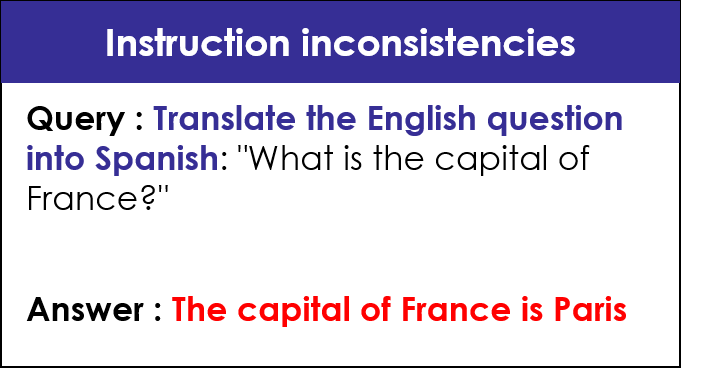
- Instruction inconsistencies: the response does not comply with the constraints or instructions specified in the prompt.
- Context inconsistencies: the model ignores, misinterprets, or contradicts information provided in the input context.

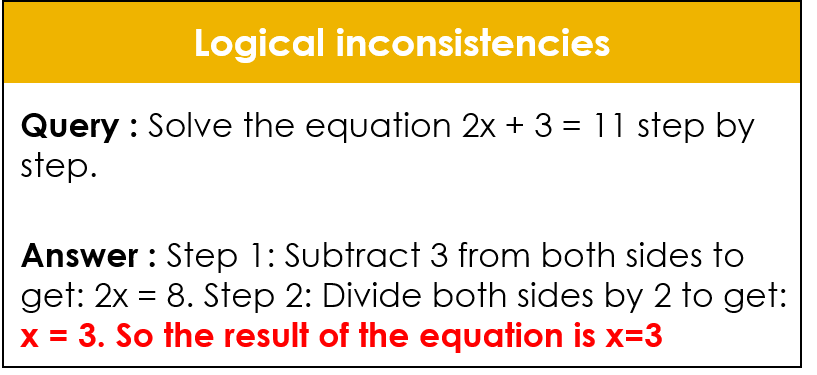
- Logical inconsistencies: the model’s reasoning contains internal contradictions or logical errors that lead to invalid or unsupported conclusions.
2. Causes and Mechanisms of AI Hallucinations
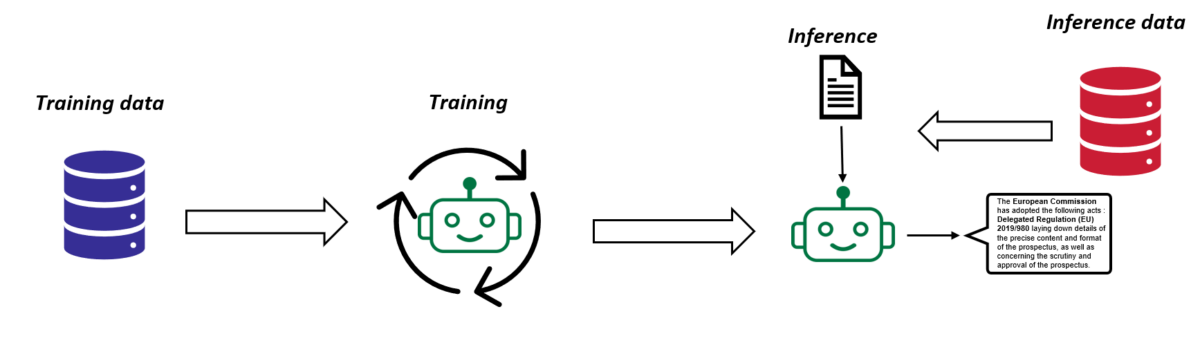
Now that we have explored the different forms and categories of hallucinations, let’s take a closer look at the mechanisms behind them. Hallucinations can emerge at various stages of a language model’s lifecycle, from data preparation to response generation. The figure below illustrates the three main phases of this process: data preprocessing, model training, and inference. Each of these stages can introduce biases or limitations that increase the likelihood of hallucinations.
2.1. Data Preprocessing
The quality of the data used to pretrain a language model has a direct impact on the quality of the responses it generates. Several factors at this stage can contribute to the occurrence of hallucinations:
- Biases and stereotypes in the training data: Language models learn the social, cultural, and linguistic biases present in their training corpora, which can lead to biased or factually incorrect responses (Ladhak et al., 2023; Lin et al., 2022).
- Outdated pretraining data: A language model’s knowledge is limited to the data it was exposed to during pretraining. Consequently, information that has since changed or become outdated may still be presented as accurate and up to date (Jiang et al., 2024).
- Uneven knowledge distribution across domains: Some domains are well represented in the training corpus, while others receive much less coverage. This imbalance explains why LLMs often exhibit varying levels of performance across different domains and industries (Metheniti et al., 2025).
2.2. Model Training
The choices made during training also influence a model’s ability to acquire, retain, and accurately reproduce knowledge.
- Learnability threshold: A fact must appear a minimum number of times during training before it can be reliably internalized by the model. Below this threshold, knowledge is only partially learned, increasing the likelihood of hallucinations (Chang et al., 2025).
- Probabilistic decoding algorithms: Some generation methods, such as sampling, intentionally introduce randomness to produce more diverse and natural responses. While this often improves creativity, it can also increase the risk of generating factually incorrect information (Zhang et al., 2025).
2.3. Model Inference
Hallucinations can also arise during inference, when the model generates a response to a user’s prompt.
- Imperfect decoding strategies: Decoding methods aim to balance response quality and diversity. Deterministic approaches may produce repetitive outputs, whereas stochastic decoding introduces greater diversity at the cost of a higher risk of hallucinations.
- Limitations in reasoning capabilities: Even when a model possesses the necessary knowledge, it may fail to retrieve the correct information or follow the appropriate reasoning process. This issue becomes particularly apparent when multiple plausible facts or associations compete, leading to incorrect or inconsistent conclusions.
3. Overview of Current Hallucination Mitigation Techniques
Hallucinations can affect virtually every text generation task, including open-ended generation, summarization, machine translation, question answering, and conversational AI. Consequently, a wide range of techniques has been proposed to reduce their occurrence and improve the reliability of large language models.
These mitigation strategies operate at different stages of the model lifecycle. Some focus on improving the quality of the pretraining data, others intervene during model training, while additional techniques are applied during inference or after response generation to detect and correct potential hallucinations.
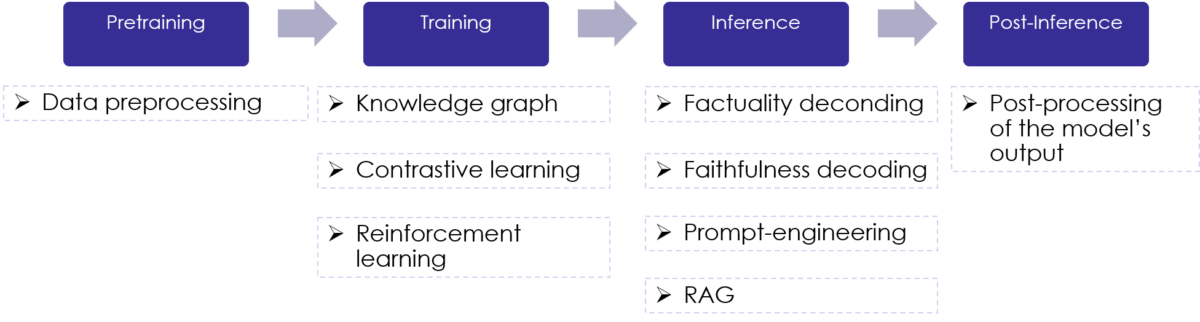
In this section, we provide an overview of the main hallucination mitigation approaches proposed in the literature, organized according to the stage of the model lifecycle at which they are applied: data preprocessing, model training, inference, and post-processing. The figure below illustrates this classification and highlights the different intervention points where hallucinations can be mitigated.
3.1. Pretraining
As discussed in the previous section, the quality of the training data is one of the primary factors contributing to hallucinations. Consequently, many mitigation techniques focus on addressing these issues during the pretraining stage.
Data preprocessing: Several works have proposed data cleaning approaches that identify irrelevant, inconsistent, or contradictory information by comparing it with trusted reference corpora. Outdated information can then be corrected, while unreliable content is removed from the training dataset.
3.2. Model Training
The training phase offers one of the most effective opportunities to reduce hallucinations, as it allows developers to directly influence the model’s behavior before deployment. Several techniques have been proposed in the literature, including:
- Knowledge graph integration, which injects structured knowledge to improve the factual consistency of generated responses.
- Contrastive learning, which trains the model to distinguish correct responses from incorrect ones.
- Reinforcement learning, often leveraging human feedback, to encourage more accurate and reliable outputs.
- Controlled generation, which introduces constraints during training to steer the model toward more faithful and consistent responses.
3.3. Inference
A number of mitigation strategies can also be applied during inference, when the model generates a response to a user’s query.
One of the most widely adopted techniques is prompt engineering, which consists of designing prompts with clear and explicit instructions. By asking the model to rely only on the provided information, cite its sources, or acknowledge when it lacks sufficient knowledge, prompt engineering can significantly reduce the likelihood of hallucinations.
Another widely used approach is Retrieval-Augmented Generation (RAG). RAG follows a two-step process:
- A retriever first retrieves the most relevant information from an external knowledge source.
- The language model then generates its response using both the user’s query and the retrieved documents as context.
By grounding the model’s responses in external, up-to-date knowledge, RAG helps reduce hallucinations caused by missing or outdated information while preserving the language model’s generative capabilities.
3.4. Post-processing
Finally, some mitigation techniques are applied after the response has been generated. These post-processing methods aim to detect, correct, or filter hallucinated content before it is presented to the user.
They include techniques such as fact verification, automatic response correction, response rewriting, and unsafe content filtering, providing a final layer of protection against hallucinations that may have escaped earlier mitigation strategies.
4. Metrics Used by our AI Research Lab to Evaluate Hallucinations
Reducing hallucinations is only the first step—their impact must also be measured objectively. Reliable evaluation is essential for comparing mitigation strategies, tracking model performance, and identifying the most common types of errors.
At the AI Research Lab, we have conducted several studies on hallucination evaluation across different use cases, including automatic legal document summarization and Retrieval-Augmented Generation (RAG) systems.
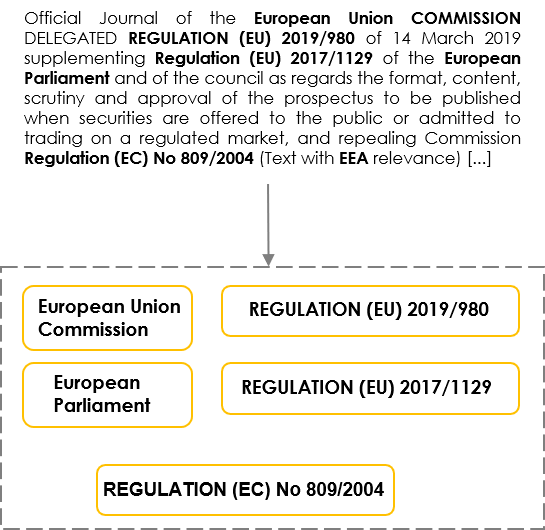
In the context of legal summarization, we focused on a recurring issue: the generation of incorrect legal or regulatory references. An inaccurate citation can alter the meaning of a summary and undermine its reliability. To assess this type of error, we developed a set of entity-centric evaluation metrics.
These metrics are designed to answer questions such as:
4.1. Are the generated entities correct?
This metric evaluates the accuracy of the entities mentioned in the generated summary—such as legal articles, legal codes, courts, dates, organizations, and other named entities—by comparing them against the information contained in the source document.
4.2. Is the summary faithfully supported by the source document?
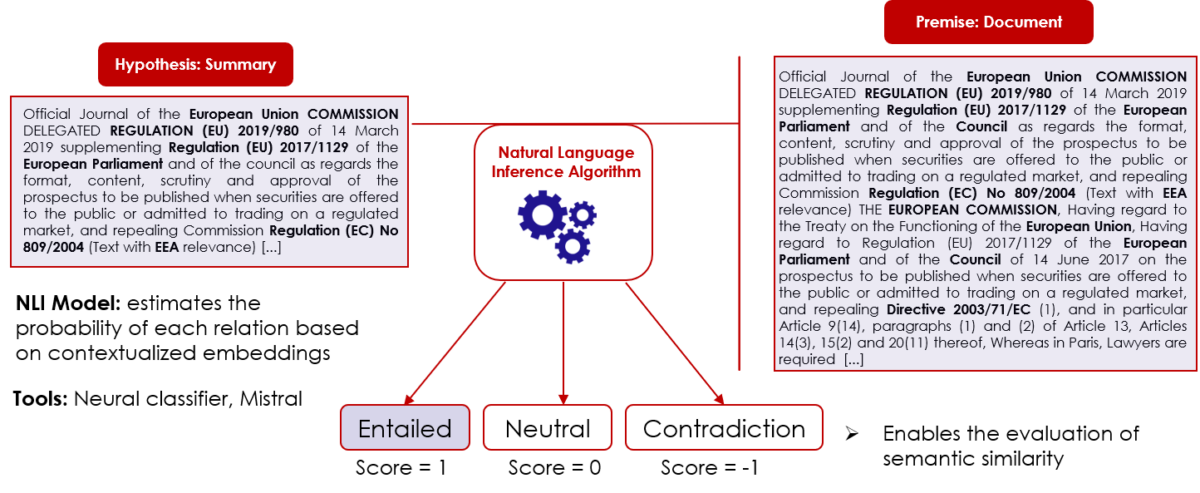
The goal of this metric is to verify that every piece of information in the generated summary is either explicitly stated in or can be logically inferred from the source document. This measure of faithfulness (or textual entailment) helps identify hallucinations introduced during the generation process.
4.3. Is the summary coherent and fluent?
Beyond factual accuracy, we also assess the overall writing quality of the generated summary by evaluating dimensions such as coherence, consistency, and fluency. A summary may be factually correct while still being difficult to understand or containing logical inconsistencies that affect its readability and overall quality.
We adopt an LLM-as-a-Judge approach, which consists of using a language model to automatically evaluate the quality of generated responses. The reliability of this evaluation largely depends on how the prompt is designed. A well-structured evaluation prompt helps produce judgments that are more accurate.
Several best practices emerge from the literature:
- Explicitly define the evaluation criteria so that the model knows exactly which aspects to assess.
- Use a clear rating scale, for example from 1 to 5 or from 1 to 10, to make results easier to interpret and compare.
- Assign a role to the model (role prompting), for example: “You are a legal expert evaluating the quality of a summary”. This helps the model adopt an evaluation framework better suited to the task.
- Provide a few short examples (few-shot prompting) to illustrate the expected output or type of evaluation.
Another useful approach is Chain-of-Thought (CoT) prompting. This technique encourages the model to explain its reasoning step by step before producing its final evaluation. By making the decision process more transparent, CoT can improve the quality and consistency of evaluations, especially for complex tasks such as summary assessment or hallucination detection.
5. Conclusion
Hallucinations remain one of the most significant challenges facing generative AI models. While it is not yet possible to eliminate them entirely, ongoing research continues to improve our understanding of their underlying causes, develop more reliable evaluation methods, and propose increasingly effective mitigation strategies.
Whether through higher-quality training data, external knowledge integration, or evaluation frameworks, reducing hallucinations requires a holistic approach. As large language models become increasingly integrated into high-stakes applications, ensuring that they produce reliable, trustworthy, and verifiable outputs will be essential to fostering confidence in AI systems.
6. Bibliography
- Huang, Lei, Weijiang Yu, Weitao Ma, et al. 2025. « A Survey on Hallucination in Large Language Models: Principles, Taxonomy, Challenges, and Open Questions ». ACM Transactions on Information Systems 43 (2): 1‑55. https://doi.org/10.1145/3703155 .
- Ladhak, Faisal, Esin Durmus, Mirac Suzgun, et al. 2023. « When Do Pre-Training Biases Propagate to Downstream Tasks? A Case Study in Text Summarization ». In Proceedings of the 17th Conference of the European Chapter of the Association for Computational Linguistics, édité par Andreas Vlachos et Isabelle Augenstein. Association for Computational Linguistics. When Do Pre-Training Biases Propagate to Downstream Tasks? A Case Study in Text Summarization .
- Lin, Stephanie, Jacob Hilton, et Owain Evans. 2022. « TruthfulQA: Measuring How Models Mimic Human Falsehoods ». In Proceedings of the 60th Annual Meeting of the Association for Computational Linguistics (Volume 1: Long Papers), édité par Smaranda Muresan, Preslav Nakov, et Aline Villavicencio. Association for Computational Linguistics. TruthfulQA: Measuring How Models Mimic Human Falsehoods .
- Jiang, Pengcheng, Jiacheng Lin, Zifeng Wang, Jimeng Sun, et Jiawei Han. 2024. « GenRES: Rethinking Evaluation for Generative Relation Extraction in the Era of Large Language Models ». Proceedings of the 2024 Conference of the North American Chapter of the Association for Computational Linguistics: Human Language Technologies (Volume 1: Long Papers), 2820‑37. GenRES: Rethinking Evaluation for Generative Relation Extraction in the Era of Large Language Models .
- Metheniti, Eleni, Swarnadeep Bhar, et Nicholas Asher. 2025. « Une revue sur les hallucinations des LLM ». In Actes des 32ème Conférence sur le Traitement Automatique des Langues Naturelles (TALN), volume 1 : articles scientifiques originaux, édité par Frédéric Bechet, Adrian-Gabriel Chifu, Karen Pinel-sauvagnat, Benoit Favre, Eliot Maes, et Diana Nurbakova. ATALA & ARIA. Une revue sur les hallucinations des LLM .
- Chang, Yurui, Bochuan Cao, et Lu Lin. 2025. « Monitoring Decoding: Mitigating Hallucination via Evaluating the Factuality of Partial Response during Generation ». In Findings of the Association for Computational Linguistics: ACL 2025, édité par Wanxiang Che, Joyce Nabende, Ekaterina Shutova, et Mohammad Taher Pilehvar. Association for Computational Linguistics. Monitoring Decoding: Mitigating Hallucination via Evaluating the Factuality of Partial Response during Generation .
- Zhang, Yue, Leyang Cui, Wei Bi, et Shuming Shi. 2025. « Alleviating Hallucinations of Large Language Models through Induced Hallucinations ». In Findings of the Association for Computational Linguistics: NAACL 2025, édité par Luis Chiruzzo, Alan Ritter, et Lu Wang. Association for Computational Linguistics. Alleviating Hallucinations of Large Language Models through Induced Hallucinations.