
This article was written in collaboration with Research Engineer Yue Cao of the Industry 5.0 Lab within Berger-Levrault’s BL Research team.
Introduction
Retrieval-Augmented Generation (RAG) combines information retrieval with the generative ability of language models. Compared with purely generative approaches, RAG first retrieves relevant content from an external knowledge base according to the user’s question, then passes that content to the language model to generate an answer [1]. The retrieved source content can serve as the basis of the answer, and updating knowledge only requires refreshing the index rather than retraining the model, so both traceability and updatability improve [2].
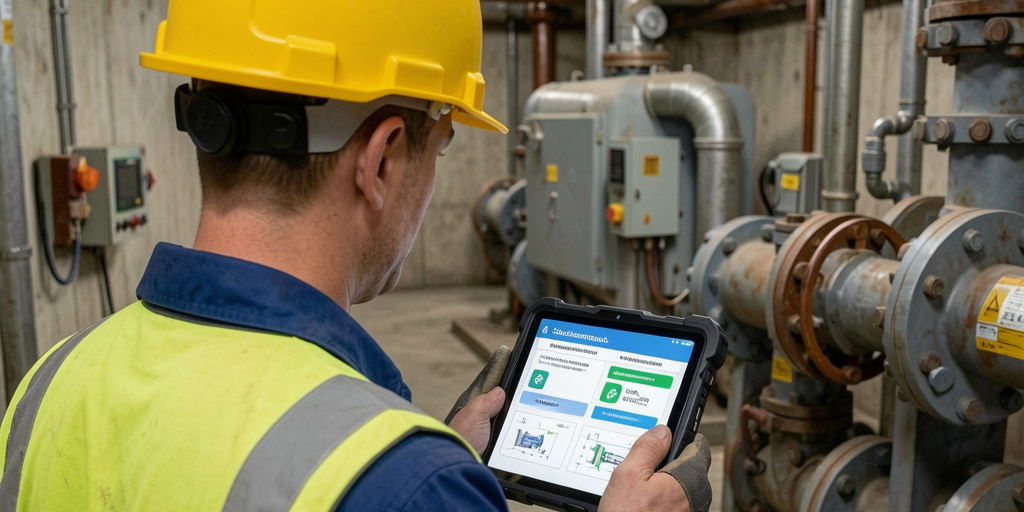
RAG needs an external knowledge source that can be searched. In this project, that source is a local assistance pack generated for one specific maintenance task. It keeps only the information related to the current equipment, work order and operation, and it holds the index and structured data required for offline retrieval. This design comes from a practical constraint in industrial maintenance. When technicians work in underground facilities, closed plant areas or places with an unstable signal, an assistant that depends on a cloud server cannot be guaranteed available [7]. Mobile devices are also more convenient for on-site work. Therefore, a small language model can be deployed on the device, while the assistance pack is downloaded in advance and used as its external knowledge source in offline scenarios. According to the principle of “garbage in, garbage out”, the quality of the pack directly affects the quality of the generated answers. The pack plays an important role in the RAG pipeline.
Development of Offline Assistance Pack Generation
Evolution
The preparation of the assistance pack can be understood as part of the pre-retrieval stage of RAG, which prepares external knowledge through steps such as document processing, segmentation and indexing before retrieval. In early RAG systems, this stage mainly relied on basic document chunking and vector indexing. To improve retrieval quality, later work introduced more refined segmentation, metadata and structured indexing strategies [2],[4]. At the same time, large language models have also started to participate in knowledge preparation, for example by extracting entities and relations for graph-based representations [5].
Innovation focus
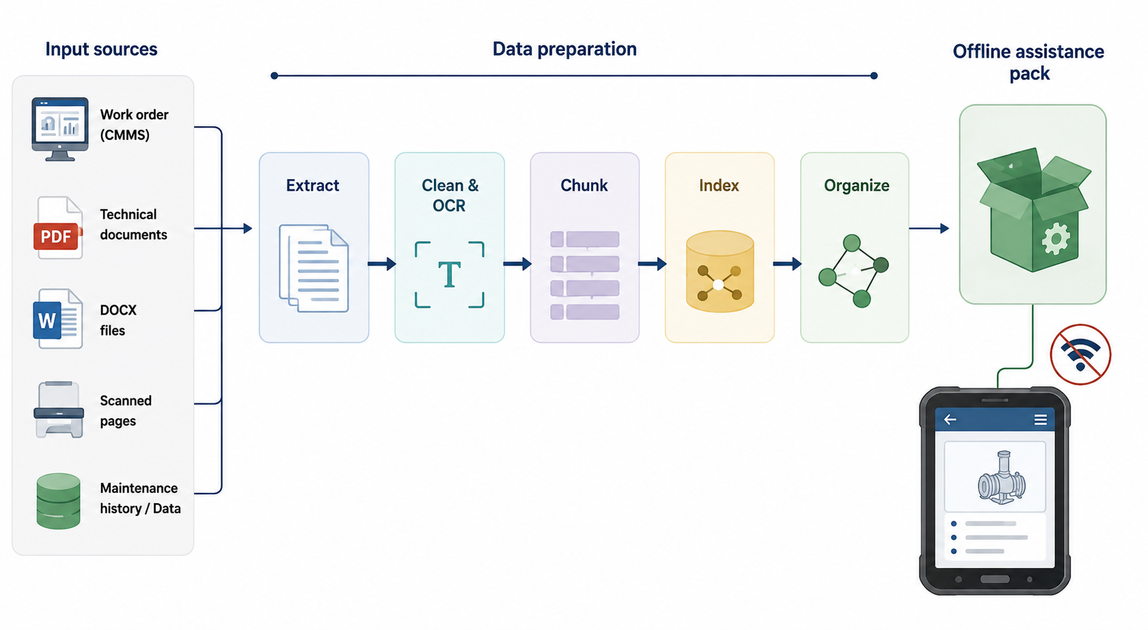
The innovation in this project is not concentrated in a single model but covers the whole process of generating the offline assistance pack. In the data processing stage, for heterogeneous sources such as PDF, DOCX, scanned images and structured data, we tested different methods of text extraction, OCR, cleaning and structure recognition to reduce duplicated content and faulty text before retrieval.
In the data organization stage, besides several methods such as fixed length, sliding window, paragraph and semantic chunking, can also use a large language model to choose the chunking method flexibly according to document structure and text type. The project uses LightRAG, which extracts entities and relations from text and complements traditional vector retrieval with a graph structure. Several small multilingual embedding models were compared, and fine tuning was tried to make the model fit the language and the task of industrial technical documents better.
The generated pack was then evaluated through the downstream RAG process. Experiments considered retrieval quality and hallucination, including prompt constraints, answers based only on retrieved content, insufficient-evidence responses and consistency between generated answers and retrieved text. The overall goal is to balance pack quality and size with mobile computing resources and answer reliability.
Use Cases
The target scenario is on site assistance without a network. CARL Source already supports deploying several autonomous databases in environments such as ships and remote mission sites where permanent communication with the central database is impossible, and synchronizes purchasing, financial and technical data over intermittent satellite or 3G/4G links [7]. Based on the equipment, task type and fault information in the work order, it filters relevant content from technical manuals and maintenance history and packages it into a local assistance pack, so that technicians can still look up operating steps, equipment parameters and safety requirements on a phone or industrial tablet when completely disconnected. A related maintenance use case is described by Zhang et al., where Bosch colleagues processed slides, PDFs and emails into chunks and stored them for maintenance knowledge retrieval [8].
What’s next?
The quality of offline assistance depends not only on the local model, but also on how the assistance pack is prepared. Errors introduced during document extraction, chunking, indexing or retrieval can affect the final answer. Future work therefore focuses on improving the stability, evaluability and resource efficiency of pack generation and its use in the offline RAG.
Scientific and Technological Perspectives
Future work can continue to improve heterogeneous document parsing, adaptive chunking [4], lightweight embedding models [3] and knowledge graph construction [5]. Evaluation can also consider retrieval accuracy and answer faithfulness [2], together with running time, memory use [3] and assistance pack size. Edge LLM deployment requires a balance between model capability, quantisation, inference speed, energy use and device resources [3][6]. At the generation stage, future work can further improve answer faithfulness and the ability to reject questions when the retrieved evidence is insufficient [2].
BL Product Aspect
Berger-Levrault has already explored the application of RAG in industrial maintenance through the Coruscant project. Coruscant is itself designed for mobile, and technicians ask questions by voice on site, but it depends on a cloud realtime API and agentic orchestration, so it requires a network connection [10]. This project fills the disconnected gap, at the cost of giving up the agent loop at runtime in favour of a knowledge pack generated before departure. The range of situations available to technicians therefore extends from connected sites to maintenance sites with no connection at all.
Part of this work has been accepted as a scientific paper at the IN4PL 2026 International Conference.
Bibliography
- Lewis et al., Retrieval-Augmented Generation for Knowledge-Intensive NLP Tasks, arXiv:2005.11401
- Gao et al., Retrieval-Augmented Generation for Large Language Models: A Survey, arXiv:2312.10997
- Pocket RAG, On-Device RAG for First Aid Guidance in Offline Mobile Environment, arXiv:2602.13229
- Wang, Z., Gao, C., Xiao, C., et al., Document Segmentation Matters for Retrieval-Augmented Generation.” Findings of ACL 2025, pp. 8063 to 8075
- Guo et al., LightRAG: Simple and Fast Retrieval-Augmented Generation, Findings of EMNLP 2025, arXiv:2410.05779
- Fan et al., MiniRAG: Towards Extremely Simple Retrieval-Augmented Generation, arXiv:2501.06713
- Berger-Levrault, CARL Source, page produit GMAO
- Zhang, H., Schmidt, W. J., Shen, X., Cao, Q., Monka, S., & Paschke, A. “Knowledge Graph Construction towards a Graph RAG-Enhanced Intelligent Maintenance Chatbot.” CEUR Workshop Proceedings, Vol. 4064, 2025
- BL Research, Explanation of the Coruscant Mobile project