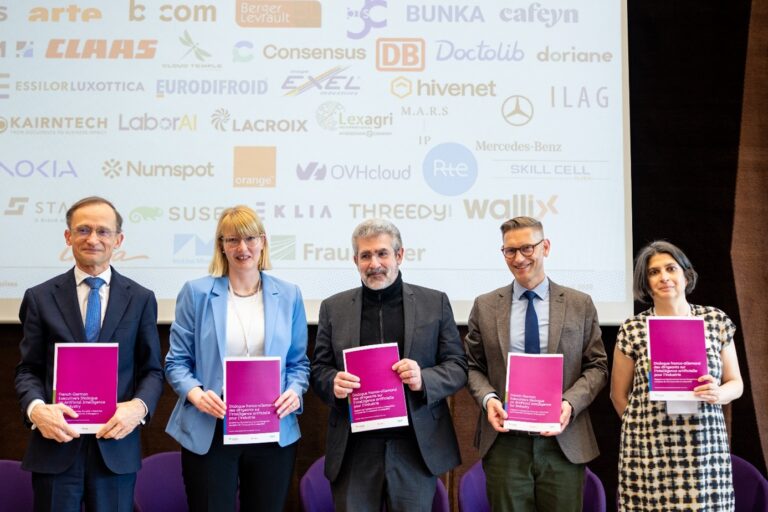


From Discovery to Business Impact Assessment: A User-Centered Method for Analyzing Generative AI
Introduction The emergence of generative artificial intelligence, and more specifically chatbots, marks a turning point in the recent history of digital technology. Unlike many professional innovations that were adopted gradually, these tools have spread particularly rapidly among the general public. Their ability to generate content, search for information, assist with writing, and support problem-solving has quickly led many users to integrate them into their daily activities. This widespread adoption now
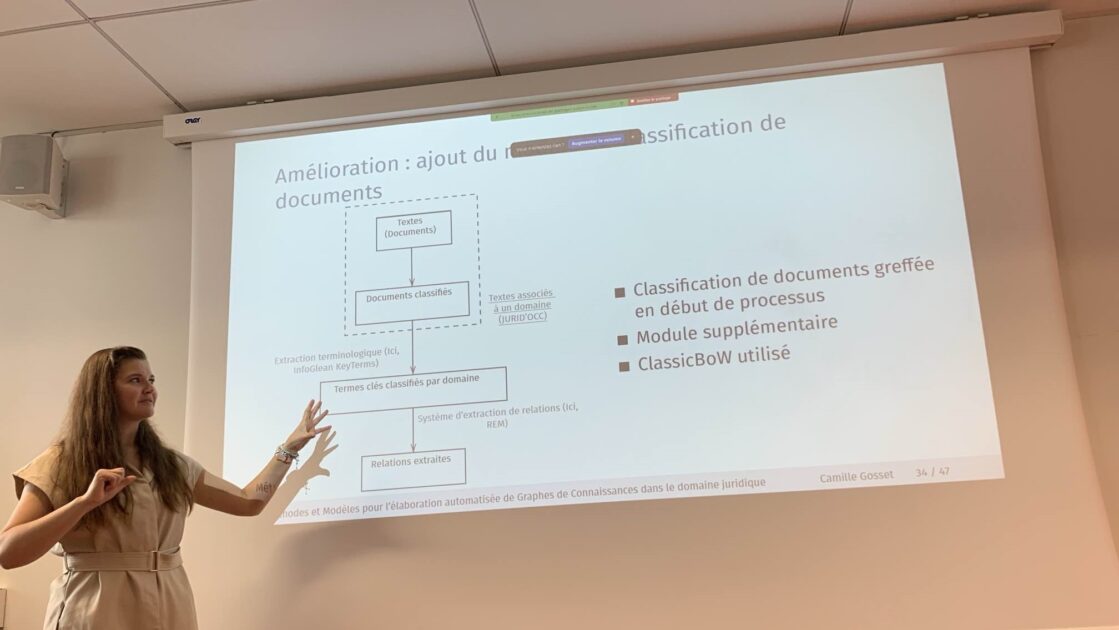
Camille Gosset Ph.D. thesis defense: “Methods and Models for the Automated Construction of Knowledge Graphs in the Legal Domain: Application to the Legal and Legal-Practical Resources of Local and Regional Authorities”
Thursday 26th of September at 10h a.m. Paris time, Camille Gosset, Ph.D. Candidate has defended her thesis named “Methods and Models for the Automated Construction of Knowledge Graphs in the Legal Domain: Application to the Legal and Legal-Practical Resources of Local and Regional Authorities”. Her thesis defense took place at the LIRM (Laboratory of Computer

CI/CD pipelines: good software development practice, but green?
Software development increasingly relies on continuous integration and deployment (CI/CD) processes. At Berger-Levrault, dozens of software applications, comprising thousands of lines of code, are developing. In the context of climate change, it is becoming essential to understand and reduce the energy consumption of these processes. When discussing the energy consumption of applications, the focus is

Model-Based Analysis and Comprehensive BRMS Migration: IBM ODM to Drools Case Study
Introduction This study outlines the process for migrating a project from IBM Operational Decision Manager (ODM) to Drools, offering a comprehensive guide for a seamless transition. Both ODM and Drools are Business Rule Management Systems (BRMS) that automate and manage business rules and decision-making logic within applications. A BRMS helps define, deploy, execute, monitor, and

BL.Predict New architecture: more security, confidentiality, availability and performance!
In the constantly evolving field of the Internet of Things, BL.Predict is continually striving to push back the boundaries to offer its customers innovative and reliable solutions. At the heart of this ambition is the transition from BL.Predict’s V1 to V2 architecture, a crucial step in our commitment to provide state-of-the-art platforms adapted to current

Webinar IA x Maintenance: Explore the benefits of AI applied to CMMS!
Discover our new Webinar: Explore the benefits of AI applied to CMMS! On Thursday, September 19 – 10:30 am to 11:30 Christophe Bortolaso, Applied Research Manager de l’équipe BL Research (DRIT) and his colleague Laurent Truscello, Product & Innovations Manager (CARL Berger-Levrault), invites you to take part in the Webinar “Explore the benefits of artificial

Enhancing Prompt Engineering using Model-Driven Engineering Techniques
In the fascinating field of artificial intelligence, an important discipline is emerging: “Prompt Engineering“. In a time where machines possess the ability to understand and generate text and code, focusing on prompt engineering becomes crucial to enhance the effectiveness and significance of interactions between humans and AI models specifically Large Language Models (LLMs). While many

Best Paper Award to Gabriel: Modest-Pharo, a collaborative work between Berger-Levrault & Inria
Gabriel Darbord started his Ph.D. two years ago in the Evref team at Inria, a joint project team with Berger-Levrault, supervised by Anne Etien (Pr.) and Nicolas Anquetil (MCF). His thesis focuses on the area of test generation, an essential component in the software development lifecycle. His research work is in partnership between: University of
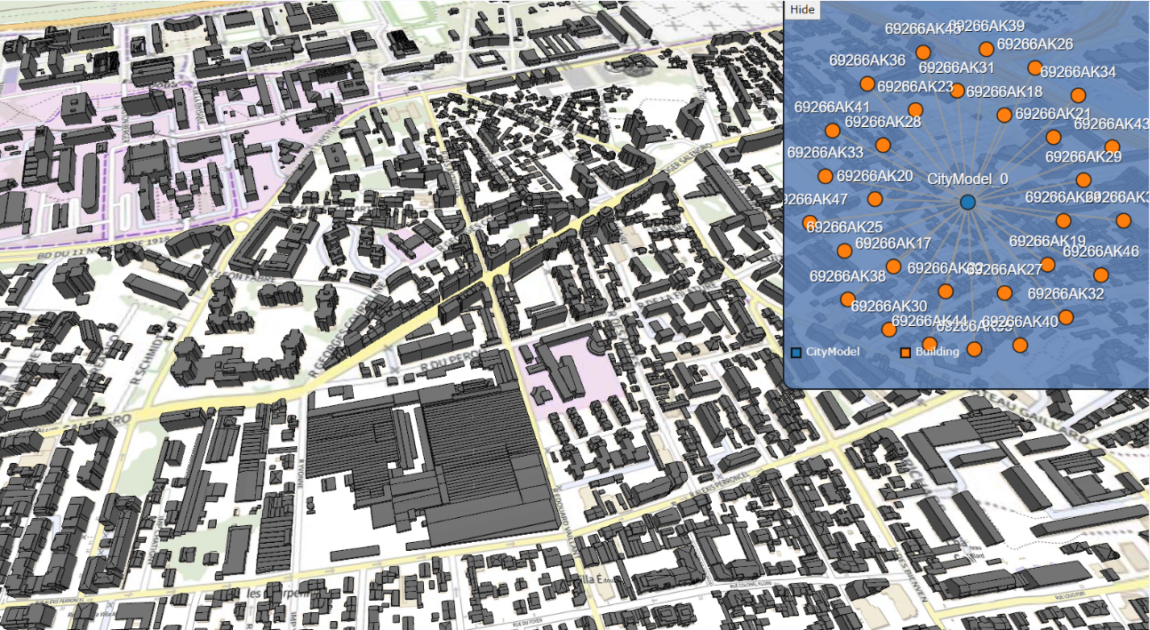
Integrating 3D geospatial data
Being able to create unified views of all kinds of geospatial data (2D, 3D, and semantic data) from the BIM and CIM domains is essential for decision-making in urban development projects and in a CMMS context. Our objective is to provide users with integrated and navigable views of available representation of urban objects through a

Not all Hallucinations are Good to Throw Away When it Comes to Legal Abstractive Summarization
The extensive use of Large Language Models (LLMs) for summarization tasks brings new challenges. One of the most important is related to the LLMs’ tendency to generate hallucinations, i.e., texts that give the impression of being fluid and natural, despite their lack of fidelity and nonsensical nature. Hallucinations can be factual: a source of knowledge,
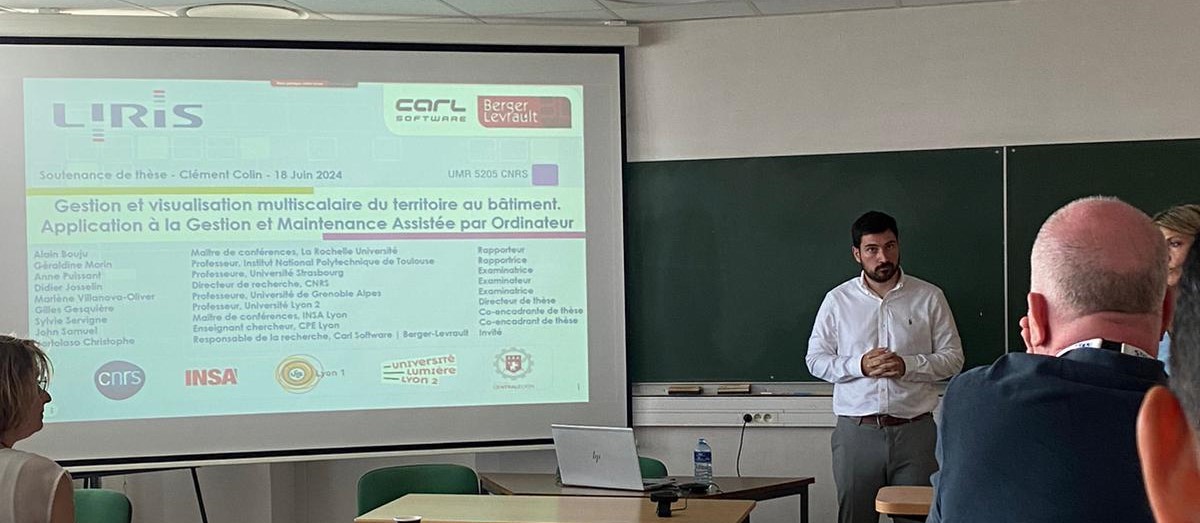
Clément Colin Ph.D. thesis defense : “Multi-scale geospatial data management and visualisation applied for CMMS”
Tuesday 18th of June at 10h a.m. Paris time, Clément Colin, Ph.D. Candidate has defended his thesis named “Multi-scale geospatial data management and visualisation applied for CMMS”. His thesis defense took place at the conference room of the Faculty “IUT Lumière Lyon 2” in Villeurbanne, France. Take a look at the summary below : Summary